The school readiness gap is not a mystery — it is a documented, measurable, and solvable crisis that begins at birth and compounds through a lifetime.
The Scale
of children in low-income countries cannot read a simple sentence by age 10 — the "learning poverty" benchmark
of South African Grade 4 students read for meaning — one of the lowest rates among 50 countries surveyed
African children never complete primary school, with early unreadiness as a leading causal factor
of critical brain development occurs before the age of 5 — the window we are largely failing to use
children under 5 in Sub-Saharan Africa — the majority without access to quality early learning environments
estimated annual loss to developing economies from the failure to invest in early childhood development
Root Causes
Families in under-resourced communities across Africa are not failing their children — they are operating within a system that has failed to provide the infrastructure, materials, and trained educators that early childhood development requires.
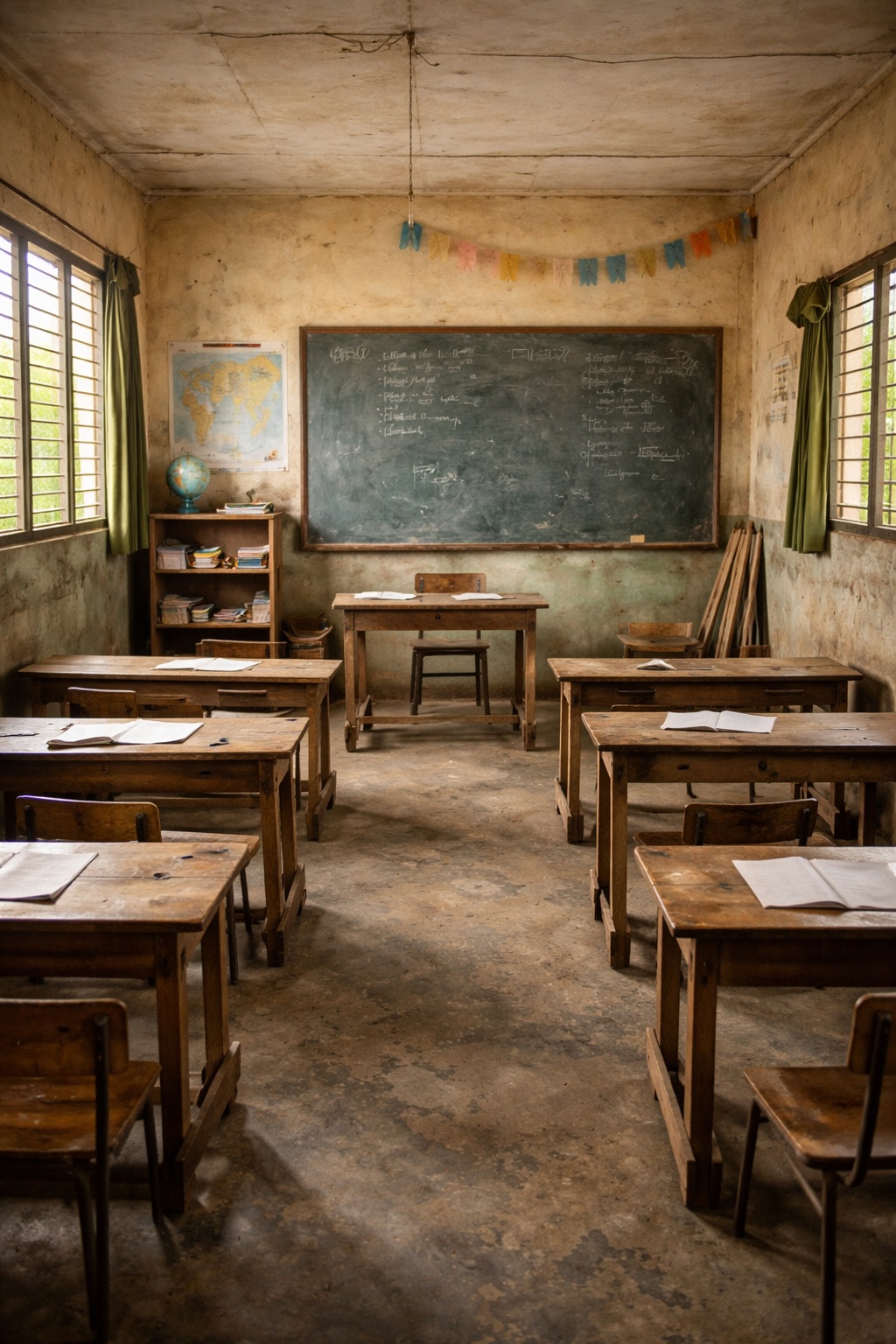
Early Childhood Development (ECD) centres in low-income areas are chronically under-resourced. Many lack running water, trained educators, or any structured learning materials. The result: children arrive at Grade 1 without the foundational cognitive, language, and social-emotional skills required to learn.
A child who is not school-ready at age 5 faces a documented cascade of disadvantages: delayed reading acquisition, higher dropout risk, reduced lifetime earnings, and — critically — a higher likelihood that their own children will face the same gap. The problem is multigenerational unless interrupted.
School unreadiness is not a child's limitation. It is a system's failure to invest in the most important developmental window in human life.
Economic Reality
The cost of inaction compounds year-on-year. The cost of action is a fraction of what under-education costs nations.
returned for every $1 invested in high-quality early childhood programs (Nobel laureate economist James Heckman)
lifetime earnings for children who participate in quality early childhood programs compared to peers who did not
likelihood of grade repetition for children who received quality early learning — directly reducing national education spending
Africa is home to some of the world's greatest natural resource wealth — yet persistent skills shortages prevent that wealth from being fully developed, processed, and retained within the continent.
The skills gap begins not in universities or secondary schools — it begins at age 3. Children who are not school-ready do not become the engineers, doctors, teachers, and entrepreneurs that Africa needs.
Solving early childhood development is not a charitable act. It is the single highest-leverage investment any African nation can make in its own economic future.
South Africa represents the challenge in concentrated form: extraordinary economic potential, an educated elite, and a mass of children locked out of quality early education by geography and income. The PIRLS 2021 data — ranking SA last of 57 countries in reading ability — is not a verdict on children. It is a verdict on the system. We are here to change the system.
Targeted, research-backed early childhood materials, deployed at scale, with a self-sustaining funding model. This is what FX Foundation is building.